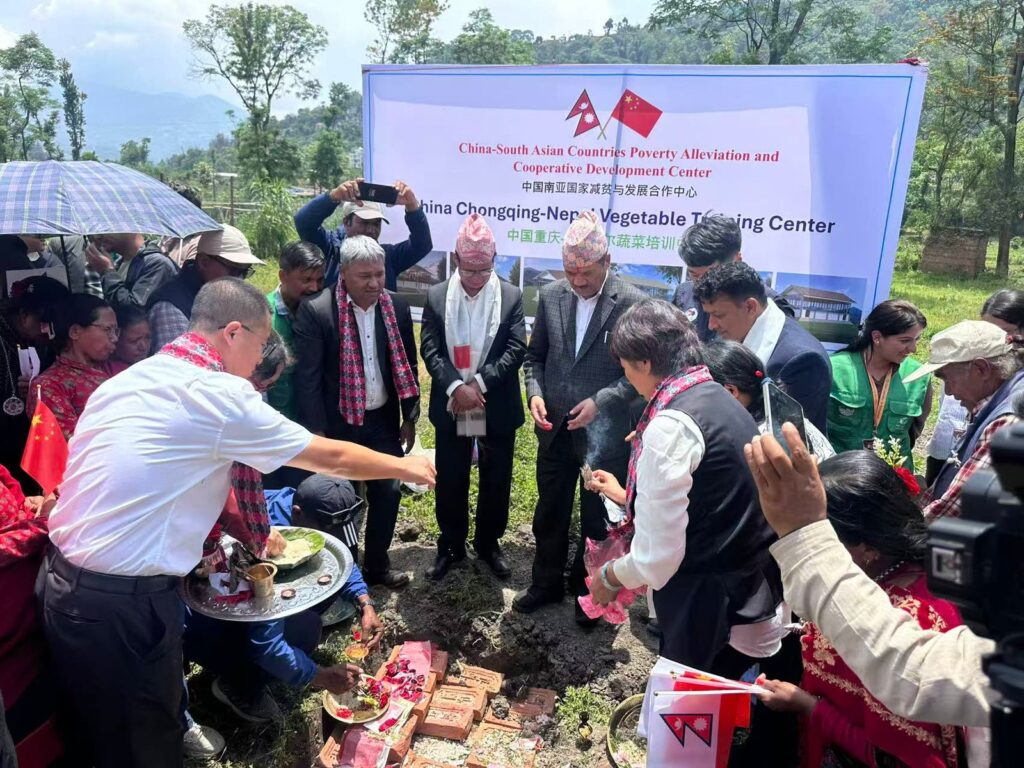
KATHMANDU – Nepal’s agricultural transformation, the China Chongqing–Nepal Vegetable Training Center was launched in Nepal’s Lalitpur district on Sunday.
The foundation stone laying ceremony of the center was held in Khokana, Ward No. 21 of Lalitpur Metropolitan City under the initiation of China Foundation for Rural Development Nepal (CFRD) Office. Along with the Center, CFRD also launched the 2026 Vegetable Technical Training Program.
According to CFRD, the program falls under the “China–South Asian Countries Poverty Alleviation and Cooperative Development Center – ‘Vibrant Village’ initiative. The initiative aims to modernize Nepal’s vegetable sector through greenhouse innovation, climate-smart agriculture, and sustainable farming systems—positioning Khokana as a living model of rural renewal.
Addressing the ceremony, Madhusudan Paudel, Minister for Agriculture and Livestock of Bagmati Province, emphasized the role of agriculture as a core of human civilization and a strong foundation of country’s economic development. He expressed hope that the project would strengthen Nepal’s vegetable sector and improve farmers’ livelihoods.
Stating that the training center would play a significant role in enhancing farmers’ technical knowledge, increasing agricultural productivity and creating employment opportunities, he shared that Nepal can learn from the modernized agricultural practices of China.
CFRD Nepal Country Director Zou Zhiqiang emphasized the importance of Nepal–China cooperation in promoting sustainable agricultural development, technology transfer, and rural revitalization.
She stated that the establishment of the training center and continued technical cooperation would strengthen farmers’ capacities through the adoption of modern agricultural technologies and improved farming practices.
The project is being implemented in Khokana, Lalitpur and Hudu, Dakshinkali, where the focus includes vegetable productivity enhancement, efficient water use, integrated pest management (IPM), balanced fertilization, and stronger institutional coordination among stakeholders.
Addressing the ceremony, Mohan Basnet, Mayor of Dakshinkali Municipality mentioned that such initiatives could help in technology and skill transfer from China to Nepal through modern farming.
Rabindra Maharjan, Ward Chairman of Lalitpur-21, expressed hope that the project would highly benefit the local farmers of Khokana and beyond as it aims to support local communities in adopting climate-smart agricultural practices. Representatives of the Chinese Embassy in Nepal, Chinese experts and professors from Chongqing, government officials, stakeholders and local farmers attended the launching ceremony.
In a powerful demonstration of knowledge exchange, China Foundation for Rural Development recently facilitated a technical visit by agricultural experts from Chongqing, China. The delegation worked directly with local farmers, walking fields, conducting hands-on training, and sharing advanced insights on greenhouse cultivation, post-harvest handling, and integrated vegetable farming systems designed to strengthen community-based agricultural economies.
Over the past year, the Chinese NGO has expanded its footprint across Nepal under the Vibrant Village Initiative, implementing flagship projects including hybrid rice demonstration farms in Chitwan, greenhouse vegetable systems in Khokana and Dakshinkali, and fishery and livestock technology projects in Jhapa. CFRD has been working in Nepal since 2015.
